
New TGR Film Starring Griffin Post Is a Real-Life Treasure Hunt
Photos by Leslie Hittmeier
“The Lost Cache,” debuting this fall after years in the making, captures a modern-day quest for historic artifacts abandoned on a remote Yukon glacier in 1937.
The chances of finding the hidden cache were, admittedly, low. A film crew and athletes from Teton Gravity Research, alongside glaciologists from the University of Ottawa, were deep in Canada’s Kluane National Park, near the Alaska border, looking for mountaineering equipment left behind 85 years earlier on a glacier that was both moving and melting.
“I had my doubts for sure,” says Griffin Post, a pro skier and POW Athlete Alliance member. The far-fetched mission was his idea. “Considering the sheer amount of things that have disappeared on the icecap, including entire airplanes, and looking at the amount of crevasses, you’re definitely not going into a mission like this with a ton of confidence.”
The resulting film, “The Lost Cache,” premieres this fall. Years in the making, the project has had POW’s support from the beginning through its Advocacy & Adventure Alliance Grants. It will screen at California’s Coast Film Festival in late October and the Banff Centre Mountain Film Festival in early November.
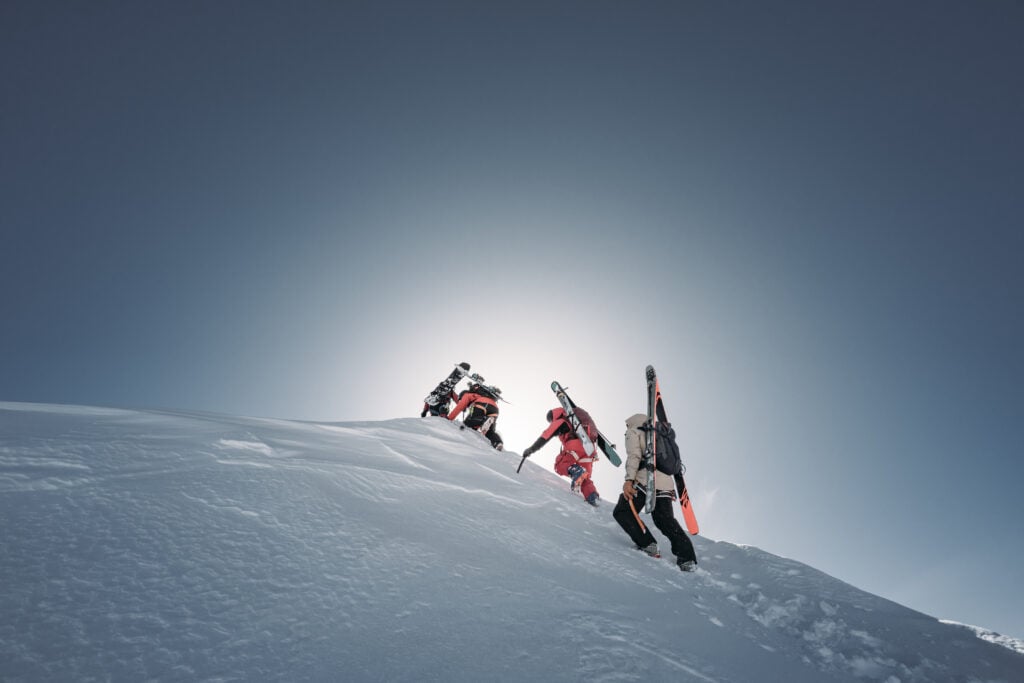
For Post, finding the missing gear wasn’t the only goal. “It almost didn’t matter if we found the cache; it still felt like a story worth pursuing,” Post says. “There’s so much good archival footage, I knew the story would be good whether we found the cache or not.”
The quest began years ago, when Post was preparing for a ski expedition in the Yukon. A fan of classic mountaineering literature, he picked up David Roberts’ 2002 book, “Escape from Lucania,” which recounts how American mountaineers Bradford Washburn and Robert Bates set out to become the first to climb 17,145-foot Mount Lucania in 1937. The two men were flown to the remote Walsh Glacier, along with their equipment. The pilot was supposed to return with the rest of their climbing team, but glacier conditions prevented him from landing again, stranding the pair more than 100 miles from civilization. They summited Lucania, then faced a grueling hike out.
Two paragraphs buried in Roberts’ book reveal that the climbers abandoned over a thousand pounds of gear, including mountaineering equipment, camping supplies, and Washburn’s large-format Fairchild F-8 aerial camera. The equipment remained on the Walsh Glacier, at the base of Lucania. Though Washburn intended to retrieve it, he never did. Washburn, a renowned mapmaker, photographer, and mountaineer, died in 2007 at age 96.
“That passage in the epilogue of the book really stuck with me,” Post says. “I thought about it for six months. I mapped and triangulated their original camp location, and that felt like a starting point.”
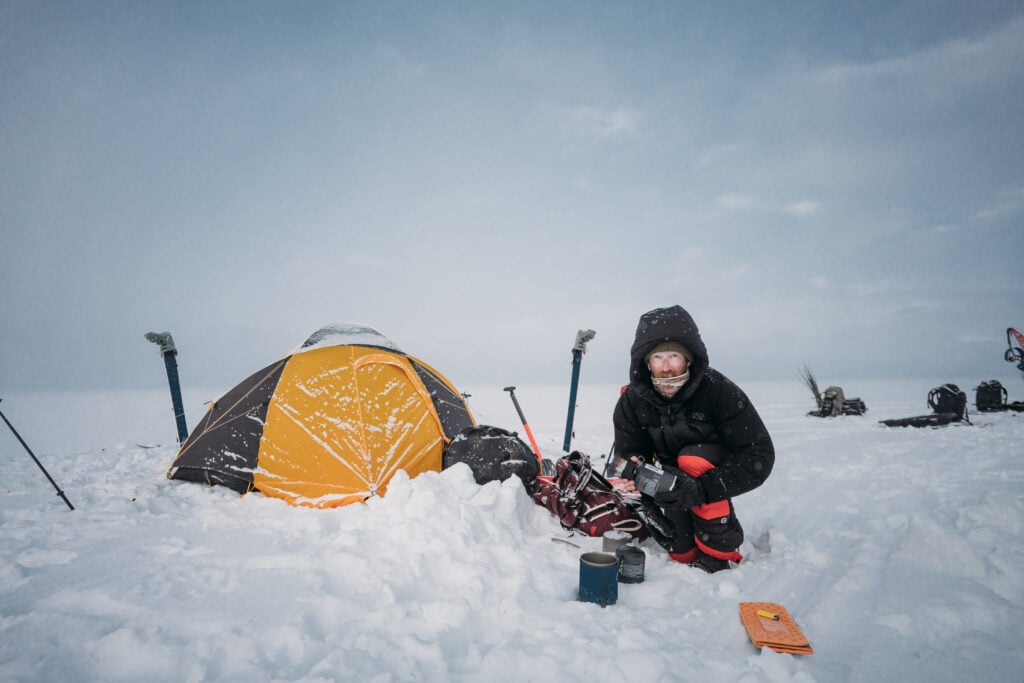
Washburn’s missing supplies became an obsession Post couldn’t shake. Using archival footage, journal entries, and photographs from Boston University, the Museum of Science in Boston, and the University of Alaska Fairbanks, Post pieced together a treasure map of sorts. “Washburn’s life was so well archived,” he says. “I had scans of all of his original journals and so much information. It was a puzzle to put together.”
He contacted Parks Canada about retrieving the gear. Staff directed him to researchers working in Kluane National Park, eventually connecting him with University of Ottawa glaciologist Dora Medrzycka, who joined the expedition. “Parks Canada gave us the permit, and was like, ‘Go knock yourselves out. There’s no chance you’re finding this,’” Post recalls.
With Washburn and Bates’ original camp location identified, Medrzycka and her colleagues had to calculate how far the equipment had traveled in 85 years. “That was the crux: Figuring out how far down the glacier it had moved. Obviously, there are huge margins of error,” Post says. The Walsh Glacier typically moves around one foot per day, but during periodic surges, it can accelerate to 50 feet per day, sometimes for months or years.
Post and his crew of filmmakers, photographers, and scientists first landed on the Walsh Glacier in spring 2022. They’d return on two more expeditions. “It was difficult to place their camp because it wasn’t easy to recognize due to the sheer amount of ice that has disappeared,” Post says. “You can’t tell this story, do this research, or find this cache without factoring in how climate change has shaped this environment over the last 85 years.”
Did they find the cache? You’ll have to watch the film to find out. As Post puts it, “Us treasure hunters are a tight-lipped bunch.”

Author: Megan Michelson
Megan Michelson is a freelance journalist based in Tahoe City, California. She is a contributing editor at Outside Magazine, an editor at large at Backcountry Magazine, and a contributor to publications like the New York Times, the San Francisco Chronicle, Ski Magazine, Powder Magazine, and more.
